
Laurent de Kiev as 'Franscesco di Vivaldi' for classical releases

The Vivaldi Project
Concertos and instrumental cycles released under the name Francesco di Vivaldi
Some admirations arrive early and never quite leave. Mine for Antonio Vivaldi has been with me for as long as I have listened to music seriously, and for most of that time it sat where such things usually sit, as a pleasure rather than a project. What changed is that I finally asked myself what it would mean to write in his manner rather than simply to enjoy him.
The obstacle was never the music. It was the sense that the Four Seasons had already been used up, played past the point of hearing, reduced to a thing that arrives while one is on hold to a bank. Recovering it required going back to what it actually is: a set of four concertos published in Amsterdam in 1725 as the opening items of Il cimento dell’armonia e dell’inventione, the contest between harmony and invention, each accompanied by a sonnet whose individual lines are printed above the corresponding bars of the score. It is one of the most tightly text-bound instrumental works ever written. Every birdcall, every barking dog, every chattering tooth is labeled by the composer.
That discovery is the seed of everything on this page. If music and words can be locked together at the level of the phrase, then the words can be changed.
The priest
There is a fact about Vivaldi that seems to me insufficiently felt, and it is not obscure. He was a Roman Catholic priest, ordained in Venice on 23 March 1703, known for the rest of his life as il Prete Rosso, the Red Priest, on account of his hair.
Within about a year of ordination he stopped celebrating Mass, citing a tightness of the chest that modern writers generally take for asthma. He never resumed. Thirty-four years later a cardinal legate refused him entry to Ferrara on the grounds that he was a priest who did not say Mass and who traveled everywhere with a singer. The refusal ruined a season and did lasting damage to his standing. He died poor in Vienna in 1741 and was buried in a pauper’s ground. His music vanished for nearly two centuries and survives today because two Turin businessmen bought a library in 1927 and 1930, one of them in memory of a dead son.
Here is a man whose vocation and whose art were pulled apart during his lifetime, and who is now known chiefly for four concertos about the natural world, which is to say about creation. He also wrote a Gloria, two Magnificats, a Stabat Mater, and an oratorio performed entirely by the orphaned girls of the Ospedale della Pietà, where he taught the violin for most of his working life. The sacred work is not a sideline. It is the same hand, in the same idiom, with no stylistic border crossed.
Taking his four concertos and giving them back a sacred subject is, for me, an act of gratitude toward that man. It seemed right to say so in the name.
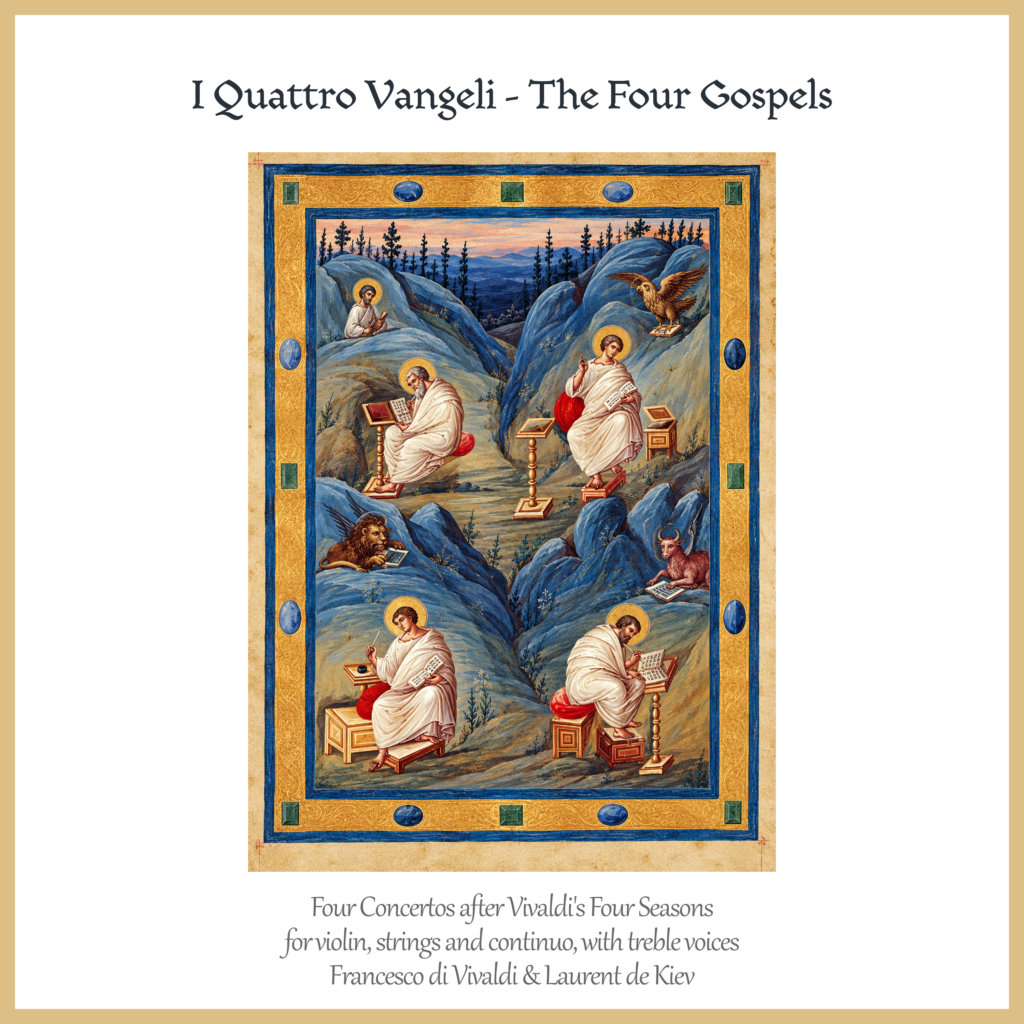
First release: I Quattro Vangeli · The Four Gospels
Four concertos, three movements each, twelve movements in all, built on the architecture of Le quattro stagioni without a bar of the music being reproduced. The keys, meters, tempo markings, forms and textures are Vivaldi’s. What is supplied is a different text underneath.
Matthew takes Spring, the gospel of fulfillment in the brightest key available to strings. Mark takes Summer, the harshest concerto in the set, for the harshest of the four gospels. Luke takes Autumn, the concerto of harvest and feast and pursuit. John takes Winter, and the case for that is made by John himself, who is the only writer in the New Testament to note flatly that it was winter.
The correspondences were found rather than manufactured. Vivaldi’s autumn slow movement is about sleepers who do not perceive what surrounds them, and Luke alone records that the disciples on the mountain of Transfiguration were weighed down with sleep. His summer finale is a storm on water, and Mark’s decisive demonstration of authority is a storm on water. The work of composition was largely a work of listening to what was already implied.
The cycle closes with a choral coda for Pentecost, scored as a Venetian festal piece with a single natural trumpet, because what follows the four gospels is not silence.
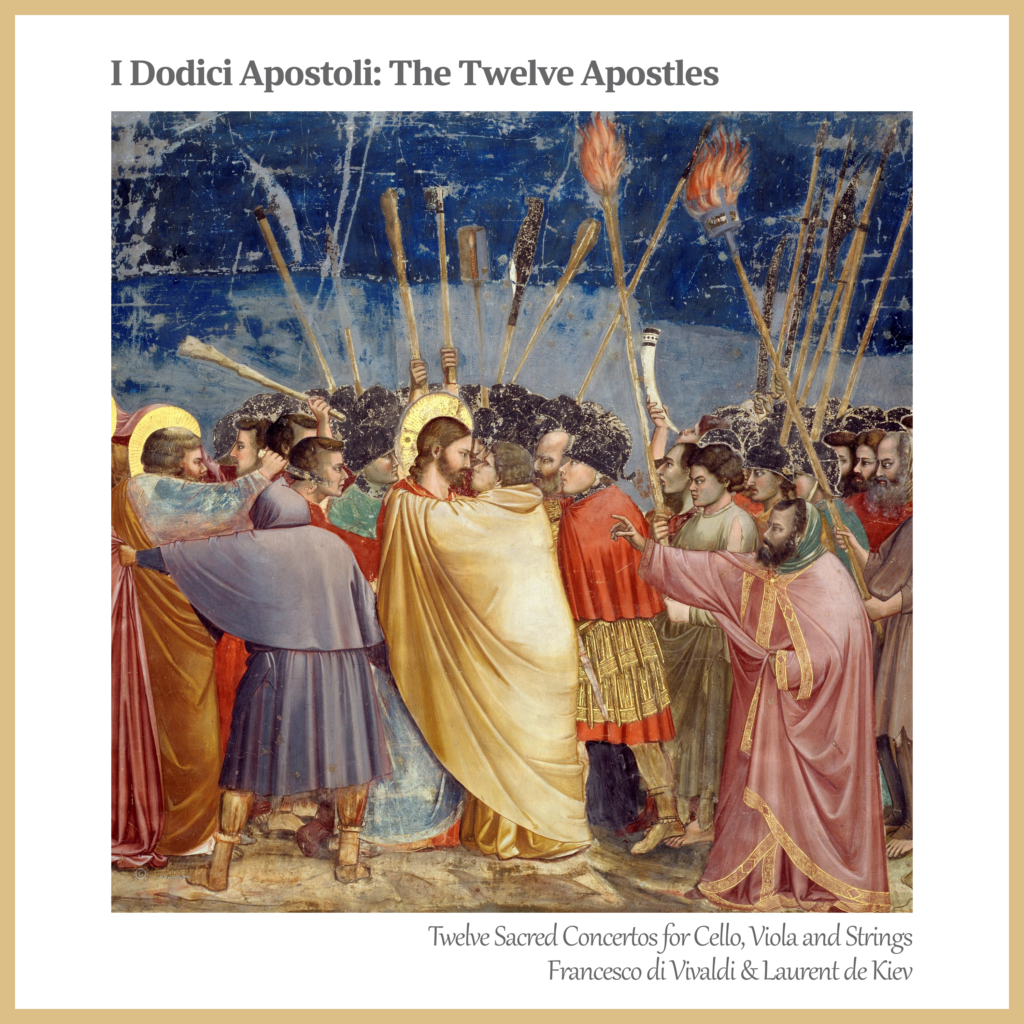
Second release: I Dodici · The Twelve
A different problem, and a different solution.
Twelve pieces, one for each of the men whom the gospels call, with a definite article and no further explanation, the Twelve. Nothing is sung on this record and no text is set, for a reason that became clear early: of the twelve men in the apostolic lists, four speak more than a sentence and four speak not at all. Two are known to us by nothing but a name and a patronymic. A cycle that gave each of them words would have to invent eleven twelfths of them.
Each portrait is carried instead by a solo cello or a solo viola, never a violin. The violin is the voice of authority in this repertoire, and an apostle is by definition a person sent, which is to say a person whose significance is conferred rather than possessed. The instruments of the middle register are the right ones for that.
The pieces vary from under two minutes to seven and a half, and the variation follows the evidence rather than compensating for it. John, who outlived all of them, receives the longest. James the son of Zebedee, whose death occupies eleven words of Acts, receives a piece that stops in the middle of a phrase. James the son of Alphaeus, of whom absolutely nothing is recorded, receives a hundred and ten seconds in which almost nothing happens, because the alternative would have been to invent him.
A thirteenth piece follows for Matthias, whose election is the last event recorded before Pentecost, and it ends where the other album’s coda begins.
The name
Francesco di Vivaldi is a workshop name of the kind the eighteenth century used without embarrassment. The particle says what such a name is meant to say: not Vivaldi, but of the house of Vivaldi. Antonio also had a brother named Francesco, through whose hands the working library appears to have left the family after the death in Vienna, so the given name points at the keeping rather than at the making, which is the more accurate description of what this work does.
Each release has a full listener’s companion setting out the twelve movements in detail, the sources behind them, and the reasoning at every point.